JUL 21, 2025
GLOBAL OFFSET TABLE (GOT) & PROCEDURE LINKAGE TABLE (PLT)
GLOBAL OFFSET TABLE (GOT) & PROCEDURE LINKAGE TABLE (PLT)
-
there are two types of linking the gcc compiler does: static linking and dynamic linking
-
static linking: all the code for the libraries used in the program is copied into the executable at compile time
-
dynamic linking: the code for the libraries is not copied into the executable, instead the code is loaded from shared libraries at runtime.
-
dynamic linking is more efficient because it reduces the size of the executable and allows multiple programs to share the same library code in memory.
-
however, dynamic linking introduces some overhead because the program has to look up the addresses of the library functions at runtime.
-
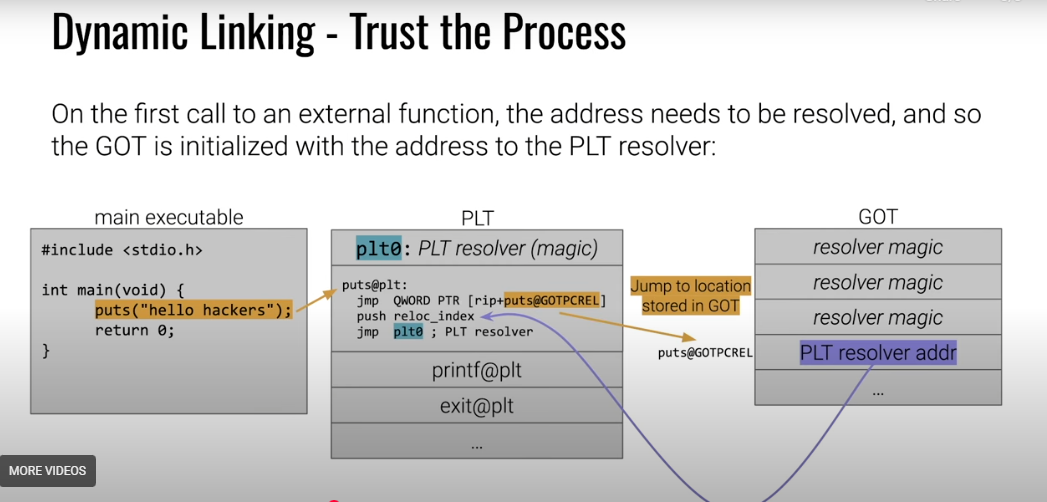
How dynamic linking works is basically handled by two features : the Global Offset Table (GOT) and the Procedure Linkage Table (PLT).
-
The PLT contains the assembly instructions that are used to call external functions from libc or other libs.
-
the got is an array for addresses or pointers that the PLT uses to call external functions.
-
When a program is compiled with dynamic linking, the compiler generates a PLT entry for each external function that the program calls.
-
Each PLT entry contains a jump instruction that jumps to the address stored in the corresponding GOT entry.
-
Initially, the GOT entries for external functions point to the next instruction in the PLT entry, which is a call to the dynamic linker.
-
When the program calls an external function for the first time, the dynamic linker is invoked.
How can we use this Binary Exploitation?
-
By overwriting the GOT entry of a function with the address of another function, an attacker can redirect the program's execution flow to the desired function.
-
For example, an attacker can overwrite the GOT entry of the
exitfunction with the address of thesystemfunction, allowing them to execute arbitrary commands when the program attempts to exit. -
this is called as ret2libc attack.
-
Another way to exploit the GOT is by overwriting the GOT entry of a function with the address of shellcode injected into the program's memory.
-
Partial RELRO allows the GOT to be modified, while Full RELRO makes the GOT read-only after the dynamic linker has resolved all the symbols.
-
NO RELRO means that the GOT is writable throughout the program's execution, making it vulnerable to GOT overwrite attacks.
-
overwriting shellcode in GOT doesnt work if NX bit is enabled.
-
so ret2libc along with ROP is the most common way in CTFS to get flags.
Full flow
Lets say an executable calls the puts function from libc to print a string to the console.
- When the program is compiled, the compiler generates a PLT entry for the
putsfunction and a corresponding GOT entry. - The GOT entry for
putsinitially points to the next instruction in the PLT entry, which is a call to the dynamic linker. - When the program calls
putsfor the first time, the dynamic linker is invoked. - The dynamic linker looks up the address of the
putsfunction in the shared library and updates the GOT entry forputswith the correct address. - The dynamic linker then jumps to the address of
putsin the shared library, and the function is executed. - On subsequent calls to
puts, the PLT entry jumps directly to the address stored in the GOT entry, bypassing the dynamic linker and improving performance.
Diagram